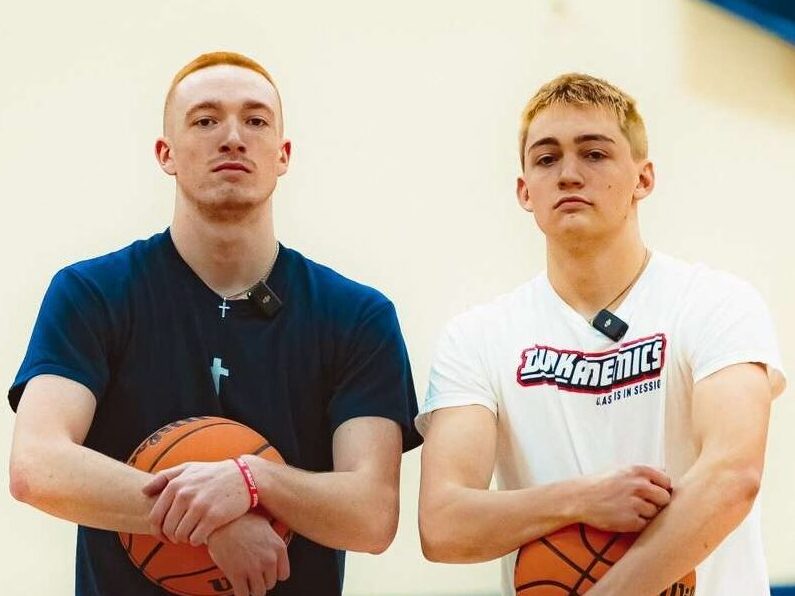
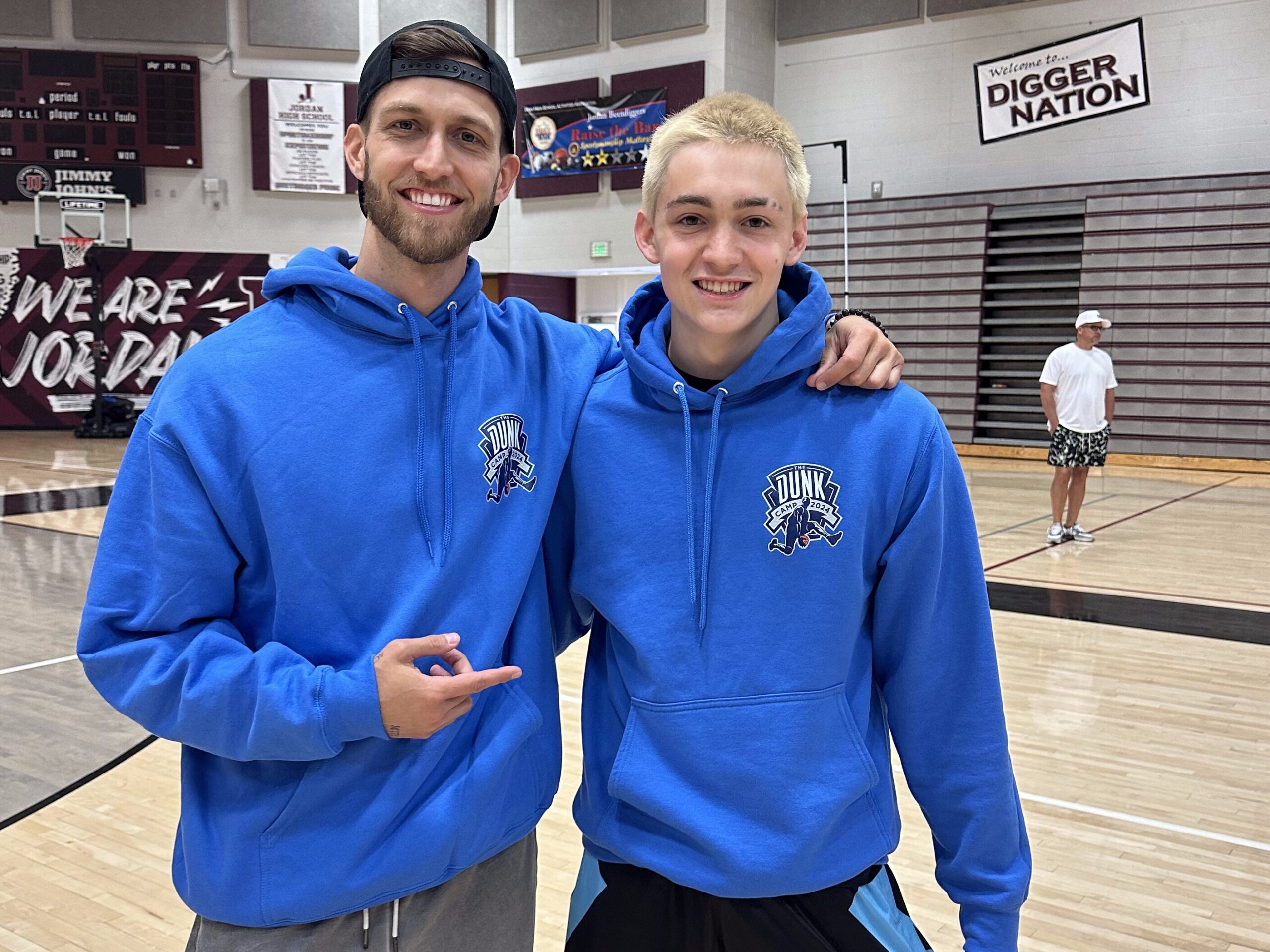
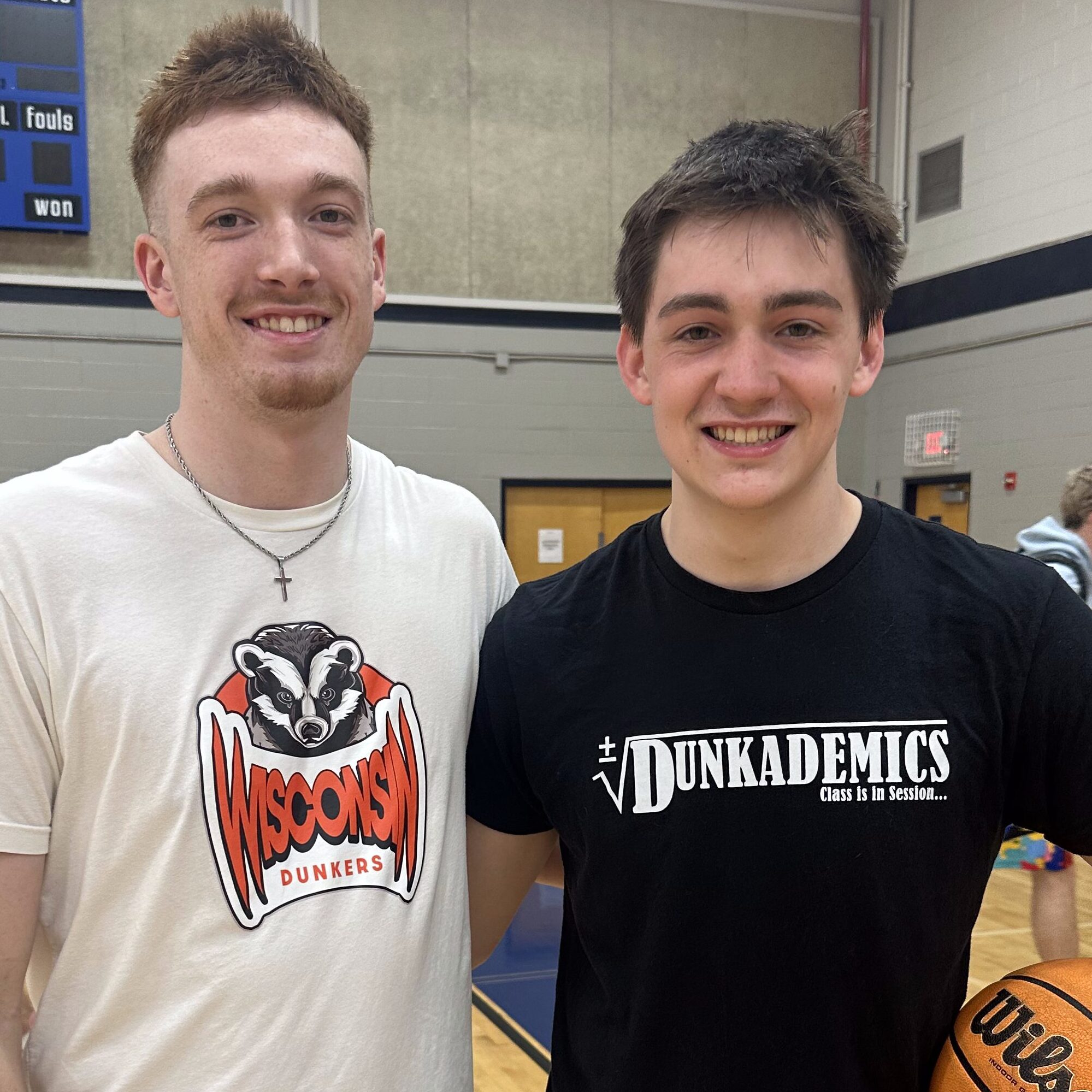
In a YouTube video from April 2024, I sat down with my friend and fellow dunker, Hunter Castona, to answer questions people sent in on Instagram and YouTube. Hunter is a 6’1″ dunker from Wisconsin, and at the time he was 21 and making his third trip up to Minnesota to dunk with me. He came up for a dunk session that we filmed later that day, but we had a few hours beforehand, so we knocked out this Q&A first. We even bleached our hair the night before, which had nothing to do with anything. It just kind of happened.
We covered a lot, from how we got started to our favorite dunks, training splits, lifting numbers, gear, fuel, faith, and the goals we were chasing. It ended up being the longest video I’d ever posted. Here’s a deeper recap of the questions and what we actually said.
1. When Did You First Get Into Jumping and Dunking?
For me, it started with soccer. I played until I was around 10, like a lot of kids do. Then I watched a Michael Jordan top 50 plays video on YouTube and something clicked. I went straight outside and started dunking on a 7.5-foot rim with a tiny ball, and that became my routine. I wasn’t really practicing basketball, I was just messing around on low rims and being creative, and somehow I got better at basketball anyway. Once I found out the pro dunk scene existed, my creativity went even further, and dunking became the thing I cared about most.
The moment it got serious for me was Dunk Camp in 2022. I’d always loved it, but that 2022 camp added real competition and a level of support I hadn’t felt before. After the 2023 camp I went all in, managing my knee pain, lifting consistently in my basketball offseason, and jumping a ton.
Hunter’s path was different. He grew up playing basketball from second grade on and dunked on low rims for fun as a kid, but he didn’t fall in love with jumping until after he stopped playing his senior year. That’s when he found the pro dunk scene and got on THP. His first camp was 2023, and he says that’s when it clicked. He hit five or six new dunks there and took third in the 10-foot contest, which is funny because he’d planned to enter the 9-foot contest until I talked him into the 10. Part of me regretted that, because it meant I actually had competition.
2. Do You Think You’ll Be a Pro Dunker Long-Term?
We both want to take dunking as far as it can go. Whether it becomes a full-time job is a different question. It’s still a small space, and even though it’s growing, it’s tough to make a living off dunking alone right now. My plan is to build around it. I’m putting a lot into digital marketing, content, and editing, so dunking can be one piece of what I do instead of the only piece.
Hunter’s more locked in on dunking itself. He genuinely believes he can be one of the best in the world, and he has the confidence to back it. When he trained in Florida with the THP guys, Isaiah Rivera told him he could hit a 50-inch vertical if he got his clean and back squat up where they should be. Hearing that from a dunker at Isaiah’s level lit a fire under him, especially in the weight room. Hunter’s also an insanely talented photographer based in Wisconsin. You can check out his work on Instagram at @Cast.Captures.
3. How Often Do You Train?
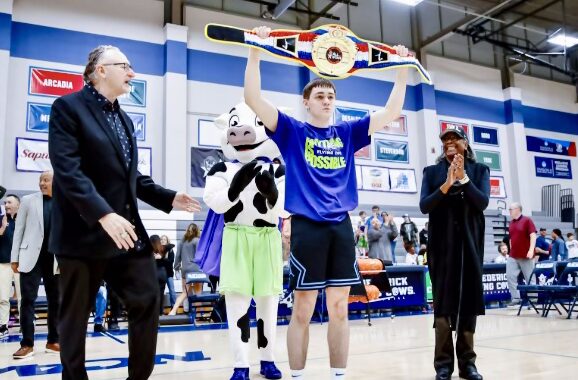
This one came in from Colton Lindquist. My setup is pretty structured. Counting dunk days, I’m training about six days a week, usually five lifts plus a dunk day. I don’t overthink the programming because Jordan Kilganon, Tom Barnes, and Austen Young handle it for me through Jump X. Deload weeks are rare for me. I’d taken one right before this session because I knew I wanted to jump out of the gym later that day.
Hunter trains six days a week too, also through THP. His split is legs Monday, upper body Tuesday, legs again Wednesday, upper Thursday, legs Friday, then a dunk or lift Saturday and an off day Sunday. Neither of us really sits still on rest days, though. We’re usually doing hand-speed work on low rims, mobility, or isometrics for knee health. If you want to build a base like that, it helps to understand what actually moves the needle on your vertical before you chase random workouts.
4. What Are the Hardest Dunks in Your Opinion?
For pure difficulty, the 360 Kamikaze and the 360 Lost and Found are at the top for both of us. The reason they’re so hard is that you barely get to see the ball. On a Kamikaze you’re spinning a full 360 while going under your leg and catching with one hand, and on a Lost and Found you’re spinning while the ball sits behind you in the same spot. Your muscle memory has to be perfect because your eyes can’t bail you out.
After those two, the third spot is wide open. We threw out the 360 Reverse Hide-and-Seek, the 360 Underboth, and the 720, which barely anyone has landed. If you want the breakdown of what these moves actually are, I keep a running list in my dunk terminology guide.
5. Favorite Dunks to Watch and Perform?
I’ve always looked up to Jordan Kilganon for his creativity, and I love Isaiah Rivera’s stuff too. Lately I’d been getting into older dunk vlogs and the Dunkademics yearly mixes, since the 2022 and 2023 ones are some of my favorite videos out there. Hunter leans on Jordan and Isaiah as well, plus T. Curry and Connor Barth when he wants right-left technique to study.
One thing we both got fired up about is raw dunk session footage. If you’re a dunker and you don’t post your full sessions, I’m probably a little mad at you, because the misses are the best part. Most of what you see on social media looks like a first try, but it’s usually 50-plus attempts before the ball goes down. Seeing the whole grind makes it real.
As for performing, at the time I was big on Eastbays and Windmills, and I’d recently unlocked reverse pumps and Cuff Windmills. Hunter’s bread and butter is the Underboth, Eastbay, Windmill, and a clean punched one-hander. One piece of advice we both gave: don’t get stuck doing new dunks on 8 feet just because you can. If a dunk won’t transfer to a 10-foot rim, it’s usually not worth your time. The 10-foot rim is the goal, so train for it.
6. What Do You Eat and Drink Around a Session?
Ben Bounces asked about pre and post-session meals. We both keep it light before we jump. You don’t want to feel heavy when you’re trying to fly, so I’ll usually have something small like chicken or a protein shake. After a good session, we feast. Chipotle and Chick-fil-A both come up a lot.
For fuel during a session, I stick with water and a little Gatorade. I hadn’t experimented with caffeine yet, mostly because the adrenaline from a big session already does the job. Hunter goes with Body Armor for the electrolytes, and since caffeine doesn’t sit well with him, he’ll grab sour candy like Sour Patch Kids for a quick sugar boost partway through. The one rule we agreed on is never eat until you’re stuffed before jumping. A little hungry is fine. Adrenaline covers it.
7. How Much Determination Does It Take, and What Keeps You Going?
Someone asked how much determination it takes to keep training without giving up. The honest answer is you can’t really measure it. It comes down to whether you actually love the thing. We talked a lot about motivation versus discipline. The motivation you get from scrolling until you find a hype video burns out fast. You build a tolerance to it and end up chasing a better clip every time. Discipline is what lasts, and the way you build it is by making training a habit. The first day is hard, the second day is hard, but if you can string together a month, you usually fall in love with the process and stop needing to force it.
The other thing people miss is patience. You don’t see results right away because your body needs time to adapt to the load. The part everyone saw was my vertical climbing. The part they didn’t see was the stretch where I worked hard and nothing happened. That’s exactly where most people quit, and no one would blame them, because they’re not seeing anything yet. If you can push through that first stretch, the results come.
Hunter brought up faith as a big part of it for him, and I’m right there with him. For him it’s talking to God about whether this is really the path, and trusting that the plan isn’t his to control. The setbacks fit that too. When I had a bone bruise on my ankle, I switched my plant foot during the recovery and came out a much better left-right dunker, which led straight to a left-right Eastbay. I learned the same lesson the hard way when a shoulder injury forced me to train smarter. Our friend Dom Gonzales is the clearest example. He tore his quad in a dunk contest and was back to his first dunk in about four months, leaning on his faith the entire way. A lot of people would have quit. He didn’t.
8. How Do You Jump With the Ball in Your Hand?
This was a technique question, and the honest answer is that every way of getting the ball up is its own skill. A lob gives you the most arm swing because you toss it and go up clean. Cuffing limits you to one motion. Off the dribble and off the backboard are completely different timings again. If you want to be a complete dunker, you have to drill all of them, not just your favorite.
We were both honest that off-the-dribble and off-vertical dunks are weak spots for us. We mostly lob or go off the backboard. That’s something we talked about prioritizing more, because off-the-dribble consistency is hugely helpful and we knew it was the gap in our game.
9. Best Shoes for Two-Foot Jumpers?
We both agreed that shoes make a real difference. I started out in whatever was comfortable and affordable, mostly Giannis Freaks. My first real jumping shoe was the Way of Wade 10, which is light with insane traction and a heel that I love. The All City 12s are solid and more budget-friendly. Since recording, my favorite has become the Li-Ning Gamma 1s. They check every box for me on traction, weight, and fit.
Hunter grew up in Kobes, Hyperdunks, and PGs. He wore some flimsy PG6s for about two years before switching to the All City 11s, and his favorite is the cherry blossom Way of Wade 10. The high, supportive heel mattered a lot for him because of his ankle bone bruise. For outdoor shoes, skip anything with a foam sole that’ll get shredded on concrete. Look for tough rubber, like the Wade Vision 8 or one of the cheaper Way of Wade models you won’t mind beating up.
10. Best Basketball for Dunking?
For indoor, the Wilson Evo NXT is the one. It runs about $100, so maybe don’t bring it to a rough gym, but it’s the best ball I’ve used for cuffing and lobs. A regular Wilson Evolution is a cheaper option that a lot of dunkers use. Hunter has a great story here. He used a school-camp ball called The Rock for five or six years, got both his first dunk and his first Underboth with it, then finally upgraded. The Rock is heavier than the Evo, which is actually decent for building hand speed.
11. Goals for the Session and the Dunk Gauntlet
We wrapped up by talking about the session we had planned for later that day. The gym we were dunking in is one of my favorites, mostly because it has a wall I can use for lobs, which I don’t have back home. I’d been saving a stack of new dunks specifically for this session. My list was long: an Underboth, an Eastbay and a Windmill off the backboard, a two-hand Windmill, an Inverted Scorpion, a Dubble Up Eastbay, and a reverse 360 Eastbay. I’d rather walk out having crossed off five dunks, even if a couple are simple, than land one big one and forget the easy ones I meant to hit.
The bigger goal hanging over all of it was the Dunk Gauntlet at camp. To earn the black band you have to hit one dunk from each category in a single session: a Scorpion, an Eastbay off the backboard, an Underboth, a 360 Eastbay, and a 360 behind the back. Only three dunkers had ever completed it. Hunter figured he could knock out one or two of those categories. I wanted the whole thing.
Final Thoughts
This Q&A was a good reminder of why we do this. If you’re into dunking or just getting started, the pattern is the same for all of it: stay consistent, train smart for the rim you actually want to dunk on, fuel right, and give your body time to catch up to the work. Everyone has off days and setbacks. The ones who keep going are the ones who actually love it.
Thanks for reading and being part of the journey.
About The Author